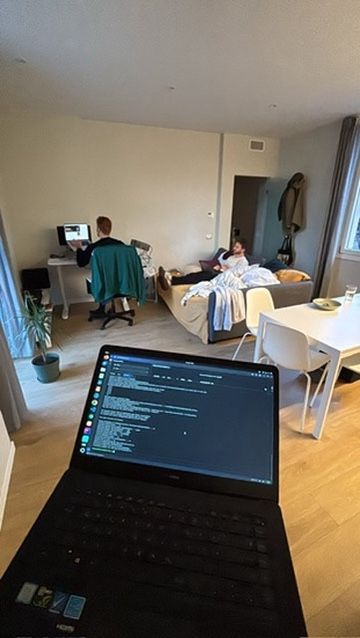
Before the demo I asked him, "Should I expect praise or should I expect you to scold me?" He picked scold. I should have taken that more seriously.
ContextContext
The call was in Russian, with my brother and co-founder Alex. The buyer runs the commercial side of an enterprise software consultancy. I showed him a Signal Engine I had built for a client that sells CRM and ERP integrations. It pulled together the CRM, the website, LinkedIn activity of owners and sellers, cold email at about 10,000 a week, and events. It had an accounts view, an AI summary for every person, and suggested actions like "send a note to the CEO," "loop in the CFO's office" or "book the pricing page." I built it with Make and Claude.
I was proud of it. He let me finish.
The callWhat happened
"Looks great, but it looks great as of five years ago."
He had connected his company's Claude to HubSpot, Outlook and Teams. He does research by prompt: "prepare, research open sources plus HubSpot." He wrote his own skill for event follow-ups. In his view you need no layer between the CRM, as the single source of truth, and Claude.
That's what a CRM was meant to be. CRM systems "compile data from a range of different communication channels, including a company's website, telephone, email, live chat, marketing materials and more recently, social media" (Wikipedia). He just added Claude on top.
He had one condition. The CRM has to be clean. "For some, CRM is a dump."
ReadHalf of my demo he had already built himself.Signal: the buyer's own setup
Alex found the part he couldn't do with a prompt.
Signals pile up over time and push you to act, so you don't have to think about who to write to this week. Tenders. Job ads that mention SAP. LinkedIn posts. Alex mentioned that his Claude costs about $100 a month.
The buyer agreed on the details. Email tracking was covered by HubSpot. LinkedIn and open sources weren't covered by anything he had. "Interesting, not a killer feature." Then, "Have to go and try."
ReadThe value is the watching, done for him.Signal: the gap
Price didn't scare him.
We quoted $2K to $4K for the setup, including two months of support. The data stays with the client, not with a vendor like UserGems or 6sense. He said that's comparable to what they spend on one event, and "no reason we couldn't pay 5K one-off."
ReadOne event is the number he compared it to.Signal: price reaction
Then he told me how to sell it.
"Start not with the interface, start with the business case. One slide. One-pager. These people think in business categories, not system interfaces."
His structure: a company we worked with, real or made up. The signals they had. What we added. The result, "led to, say, 10 new opportunities." Then the offer: you surely have signals you don't monitor, for a modest one-off fee we'll help you set them up, and later you add more yourselves. "All this can be said in 20 minutes."
The case has to come from the buyer's industry. There's old research behind this. In a UK study, existing suppliers were the top channel IT buyers used to find new solutions, but more than 50% felt their suppliers' marketing was poor. Buyers want relevant proposals and rarely get them. A cybersecurity case shown to a fintech buyer is irrelevant.
And one more line I wrote down: "Before I understand I need it, I must learn it's possible." So list the signals you can connect. Reddit, LinkedIn, tenders. For a free presale, ask, "How do you feel about tracking this signal?"
ReadSell the case, then show the screen.Signal: buyer advice
The one page he asked for
- 01A company we worked with
- 02The signals they had
- 03What we added
- 04The result: "led to, say, 10 new opportunities"
- 05The offer: a modest one-off fee to set up yours

"Before I understand I need it, I must learn it's possible."The buyer, on why you show the menu of signals
He handed us a signal with a date on it.
Companies running SAP SRM lose support at the end of 2027. "It's burning for them." Alex said, "Great signal right there." I promised to reach out to a contact at SAP about it.
ReadA public deadline is a target list.Signal: end of support, December 2027
BreakdownTactical breakdown
What I did
Asked to be scolded, then showed the interface for most of the call. At one point I said a contact had "worked in Cloudera for 20 years." He corrected me: not Cloudera, 20 years in sales. I was reading the screen instead of listening.
What went wrong
I led with the product to a buyer who had already built most of it with a prompt. I had no one-pager and no case from his industry.
What went right
Alex named the real gap: signals that pile up and tell you who to write to this week. The buyer agreed on the price without a fight. And we left with a dated signal for his own market.
What I'll do differently
Every first call starts with one page. Industry case, signals, what we added, the result. The demo comes after, and only if he asks. Our landing page gets a simple offer: send us your accounts, get 3 to 5 signals for free.
Steal thisSteal this
Tick what you will try this week
ClosingClosing
After we hung up, Alex and I sat there for a second. Then I said, "Guys, I've gone crazy." I was the only one who had asked to be scolded.
Lines marked (Wikipedia) are quoted from English Wikipedia as it was before November 2022, used under CC BY-SA. Photos by Stefan Repin. GIF via GIPHY.

About the author
Stefan Repin · LinkedIn
Builds signal and scoring systems for B2B companies with long sales cycles. Co-founder of Telltale with Alex Repin. Writes a field note from real sales calls most weeks.