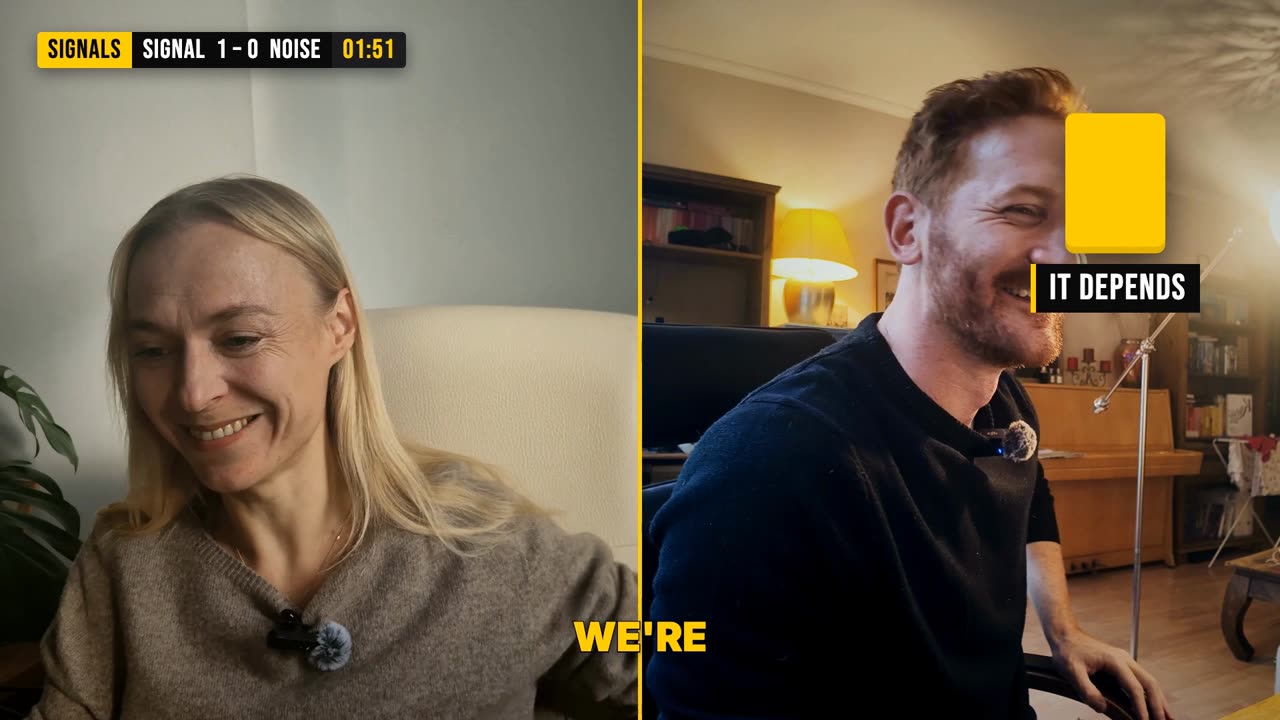
I asked Emilia what buyer intent is and she didn't give me a definition from a vendor deck. "Some sort of measure of how likely someone is to be in the market." Then she told me how most companies build that measure. They pick a signal, or a few, score the accounts, draw a line, and call everything above the line "in market."
I do the same thing. That's why this episode stayed with me for a week.
ContextContext
I build signal and scoring systems for B2B companies. Every client asks me the same question in the first call: which signals matter? My honest answer has always been "it depends," and then I pick thresholds that feel right. Three clicks in 30 days is hot. A webinar signup is an MQL. Emilia said it on the show: those numbers were guesses, because to do better you needed a data scientist. Most marketing teams never had one.
She doesn't have one either. She has Claude connected to her CRM.
Wikipedia described the goal years ago: a good scoring model is measured by "its ability to identify a subset of prospective buyers who will account for a significant portion of sales opportunities" (Wikipedia). Emilia is one of the few people I know who actually checks that.
The callWhat she said
The best signal depends on what your product does.
Funding is overplayed. Everybody gets "Hey, congrats on raising" and everybody deletes it. Hiring is better, but only one kind of hiring: when a company hires for the persona that uses your product. For ZenABM, the telltale sign is a company running more LinkedIn ads. You can check that in the LinkedIn ads library. Her rule to generalize it: look at your product's value metric and watch it grow at the account. Her Buffer example was a company posting more and hiring social media managers.
ReadThe signal sits in what your product counts.Signal: product value metric
She measures signals against deals, and gave it a name.
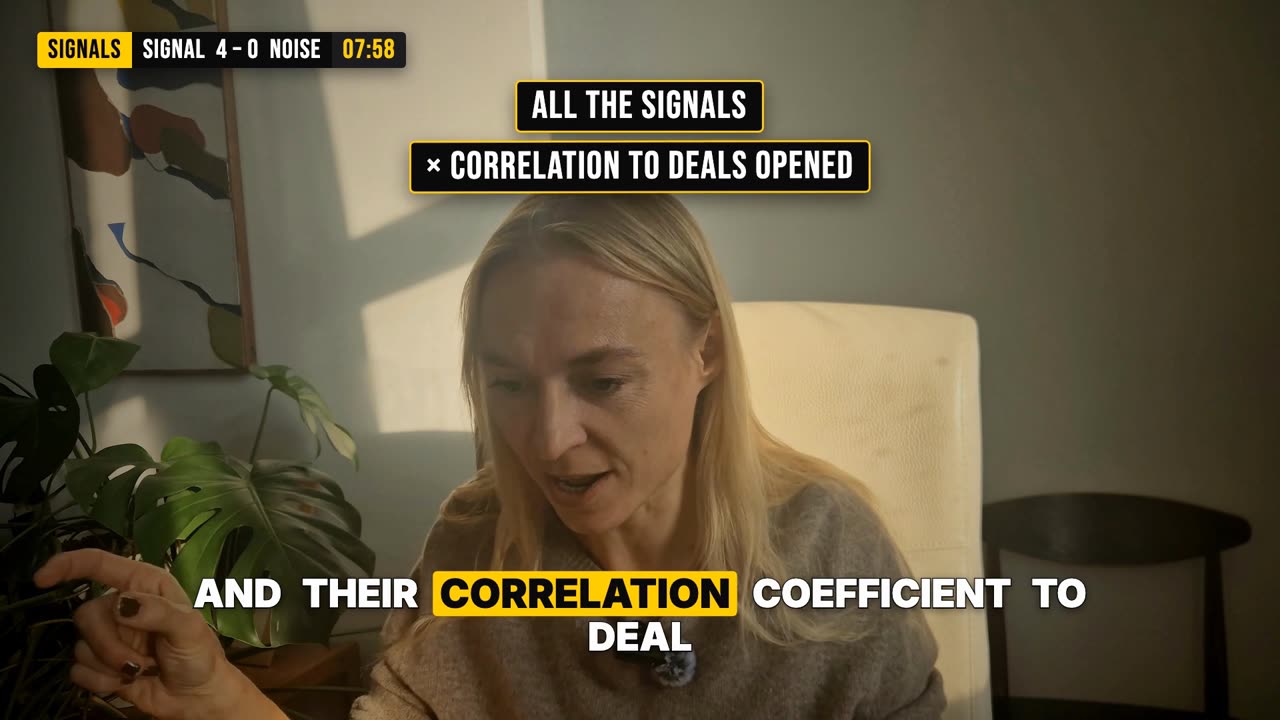
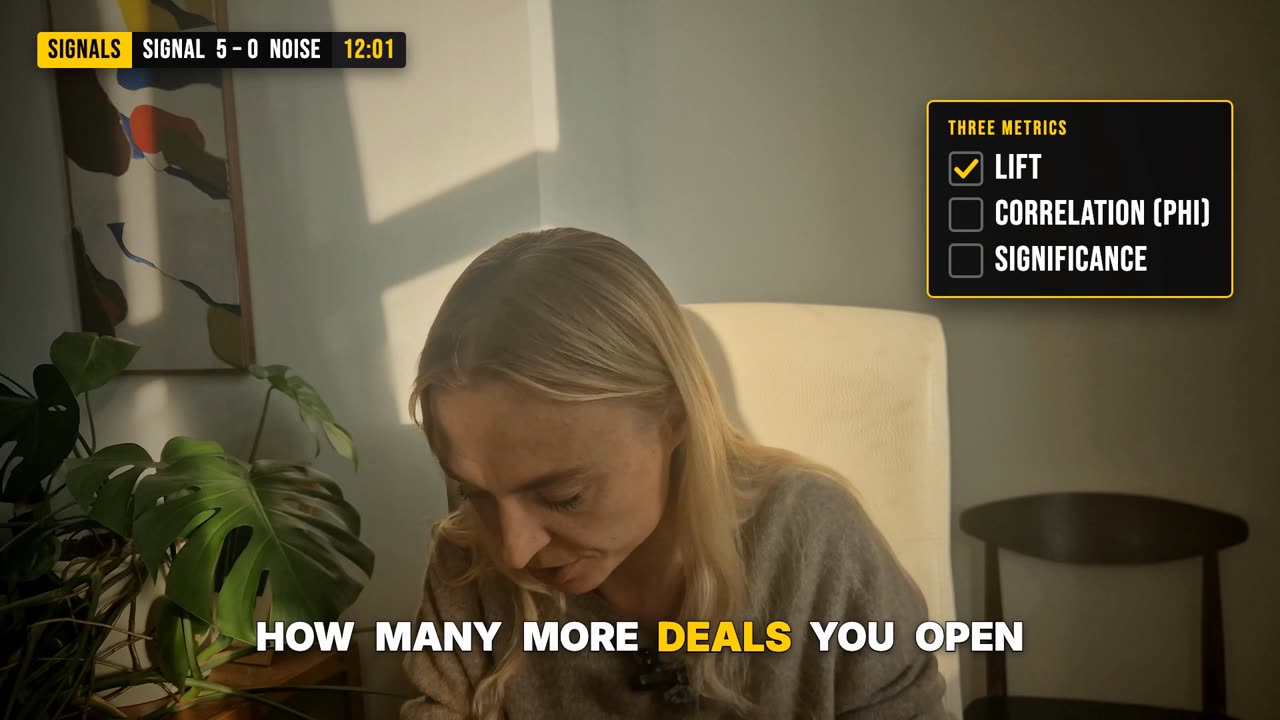
She calls it DOLR, Deal Open Likelihood Rate. Each signal gets weighted by how strongly it correlates with a deal being opened. She dumps the signals and the deals into Claude and asks for three numbers per signal: lift, phi and significance.
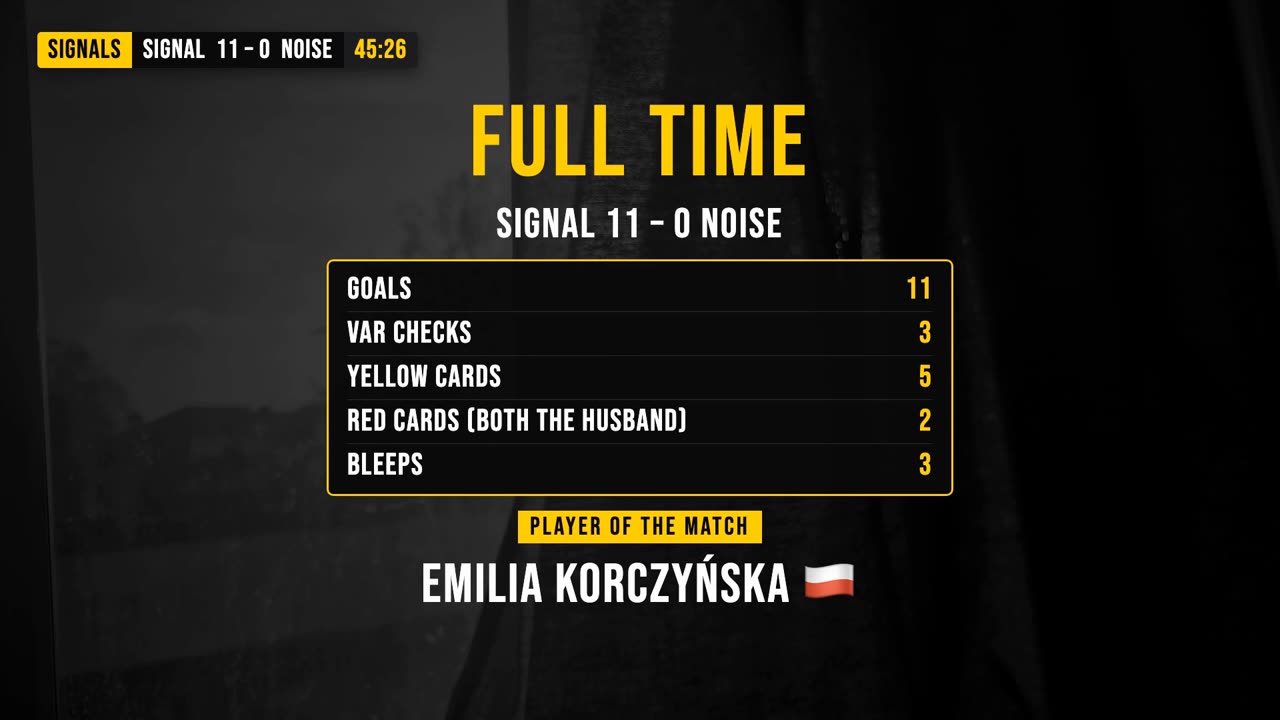
Lift is how much more often a deal opens when the signal is there. The old textbook version: lift measures how well a targeting model does "measured against a random choice targeting model" (Wikipedia). A lift of 1 means the signal and the deal have nothing to do with each other. Phi is a correlation coefficient between -1 and 1, built for exactly this case: "a measure of association for two binary variables" (Wikipedia). Signal yes or no, deal yes or no. Significance tells you whether the result could be luck. Ronald Fisher suggested one in twenty, 0.05, as the cutoff back in 1925. Her warning: lift alone misleads on small samples. And in B2B every sample is small. She had about 50 deals in 180 days. ("My husband is lame and hasn't been opening any deals." CRM hygiene, in one sentence.)
ReadLift needs a second number next to it.Signal: correlation to deal open

The example I keep thinking about.
Signal: five or more engagements. 582 companies had it. 7 of them had an open deal. That's about 1.2%, against roughly 0.1% for everybody else, so the lift is over 12x. Sounds amazing. Phi was 0.042. Weak, but not random. In B2B, she said, anything over 0.1 is already strong, because deals are rare.
What I liked most: this is close to incrementality testing without holding anyone back. The group without the signal already sits in your CRM. You don't have to build a control group. You have one.
Read12x lift, 0.042 phi, still worth keeping.Signal: 5+ engagements
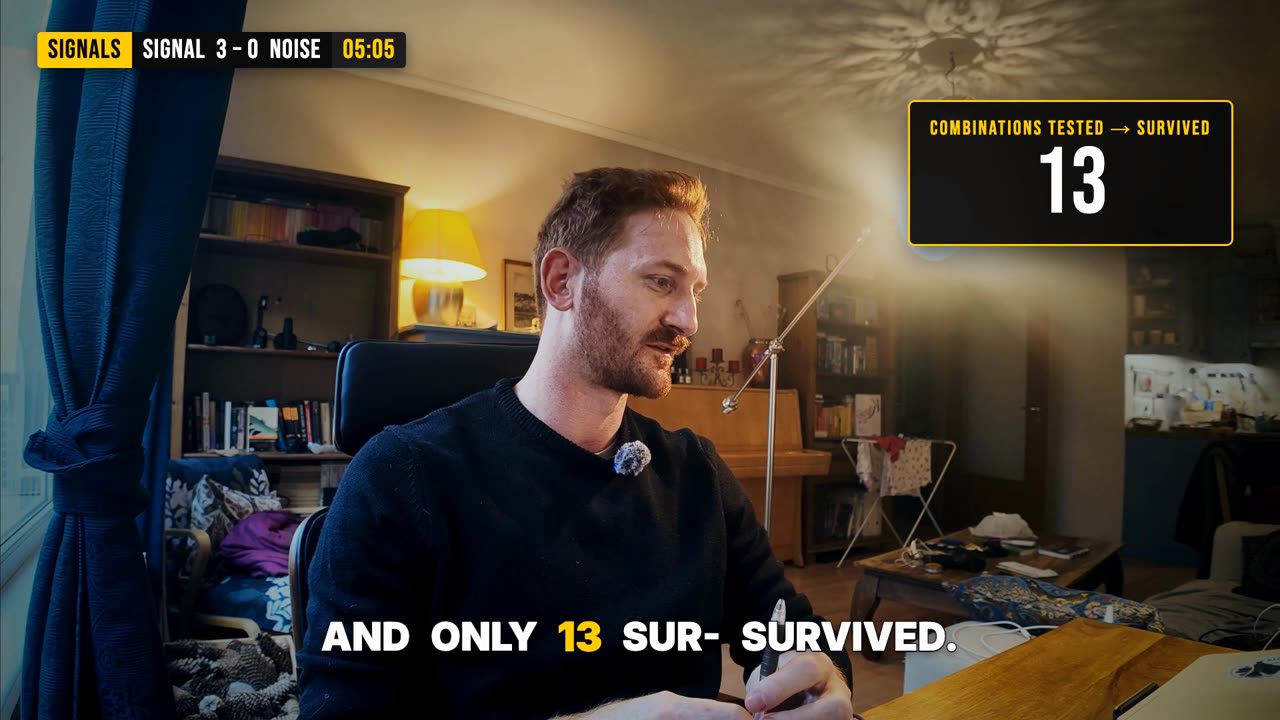
She asked Claude to test more than 1,000 combinations.
It took about two hours. 13 came out significant. Some were too narrow to use: carousel impressions plus a document click had 13.9x lift, on a group too small to matter. Others were broad enough to run a program on, like 1,000 impressions plus 50 engagements.
All 13 now feed one ABM stage she calls "interested from signals": any of them in the last 180 days. That stage becomes a retargeting audience and a prospecting list.
Read13 out of 1,000+ survived.Signal: combinations

"Some sort of measure of how likely someone is to be in the market."Emilia, on what buyer intent is
The checks before anyone gets an email.
This list is the part most teams skip. Before outreach she checks: is it a customer, a partner, or someone we already talk to; did they book a demo, start a trial or no-show; is it an agency or in-house (an LLM judges this five times and she takes the average, because it contradicts itself); are they running LinkedIn ads; employee count; are the contacts already in HubSpot, so she doesn't pay credits twice; is the contact already in another stream.
ReadHalf of a good signal program is who you leave out.Signal: exclusions
She doesn't let AI write from the signal.
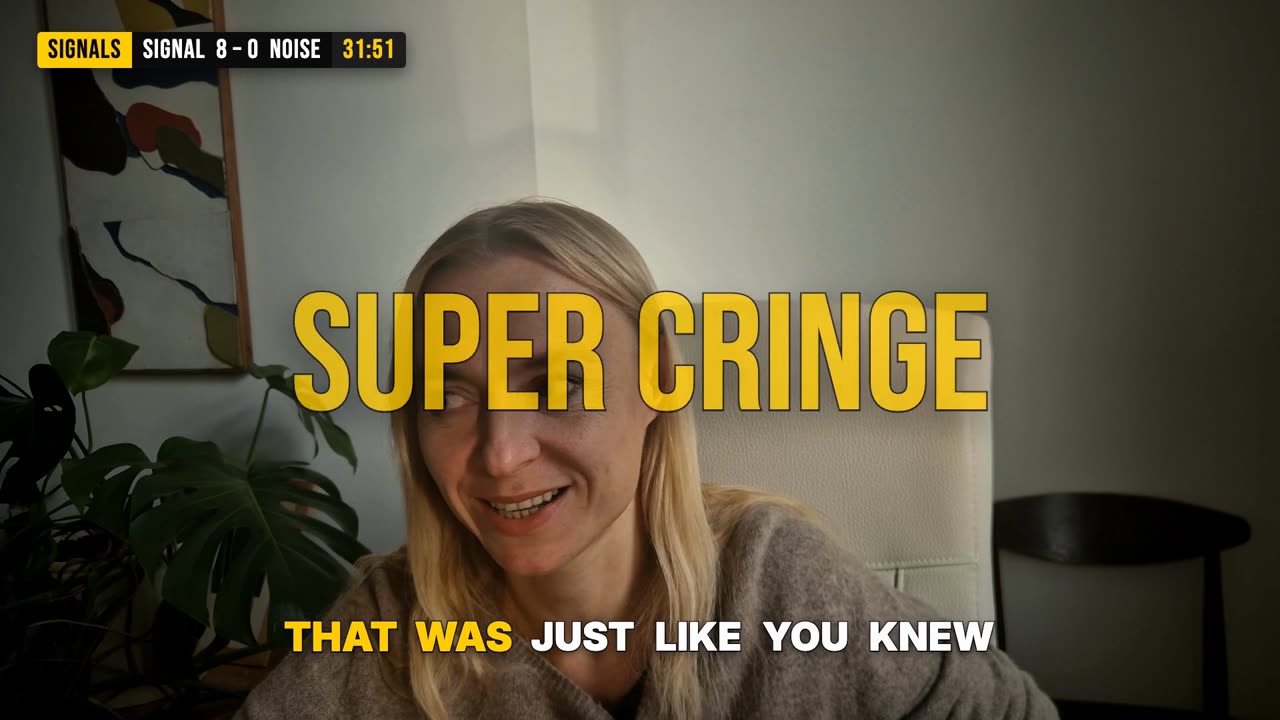
Dynamic copy built from signals is "super cringe," she said, and instantly reads as AI. She runs four intent streams with fixed copy per stream and spintax for variety. The follow-up offers a Claude skill that runs an audit, instead of another link.
Results after about a month: around 5% reply rate, 74% of replies positive. So roughly 3% positive replies. Her bottleneck is volume. Only so many accounts show signals, limited by her ad budget and a low contract value, so she will need to go cold soon.
ReadThe signal picks the stream, a human wrote the words.Signal: fixed copy
BreakdownTactical breakdown
What I did
I asked about intent and got a statistics lesson. I also told her the story of a two-sentence community pitch I got once, €50 a year, honest about what it was. I said no, and thanked him for being straight. In Europe, being upfront works. I come bearing gifts.
What went wrong
My own scoring still runs on thresholds I picked because they felt right. Fit, behavior, intent, recency. I have never checked one of them against the deals my clients actually opened.
What went right
She showed the weak number. 0.042 is the kind of result most people hide. She kept the signal anyway and explained why.
What I'll do differently
Every client engine gets a correlation pass before we lock thresholds. Signals in one column, opened deals in the other, lift and phi and significance for each. And I'll ask clients to clean deal records first, because 50 deals is already thin.
Steal thisSteal this
Tick what you will try this week
ClosingClosing
At the end I asked for her favorite ad. PostHog, with a hedgehog and a fashion line. I said ZenABM should do glasses instead of T-shirts. She didn't run a correlation on that one.
Lines marked (Wikipedia) are quoted from English Wikipedia as it was before November 2022, used under CC BY-SA. Stills from Signals episode 1. GIF via GIPHY.

About the author
Stefan Repin · LinkedIn
Builds signal and scoring systems for B2B companies with long sales cycles. Co-founder of Telltale with Alex Repin. Writes a field note from real sales calls most weeks.