I used the same word twice last week and only caught it when I read the transcripts. Hm. Let me go through the week backwards, because I think it makes more sense in that direction.
The word was ripened. On Thursday I said it about a company. On Tuesday I said it about buyers in general. I didn't connect the two until later in the week.
ContextWhy this one is about when
I build signal and scoring systems for B2B companies with long sales cycles. Last week I had a defense pitch on Friday, an intro call with a newly hired CRO on Thursday, a technical session for an ABM client on Wednesday and a client sync on Tuesday.
I spent most of the meeting talking about who to target.
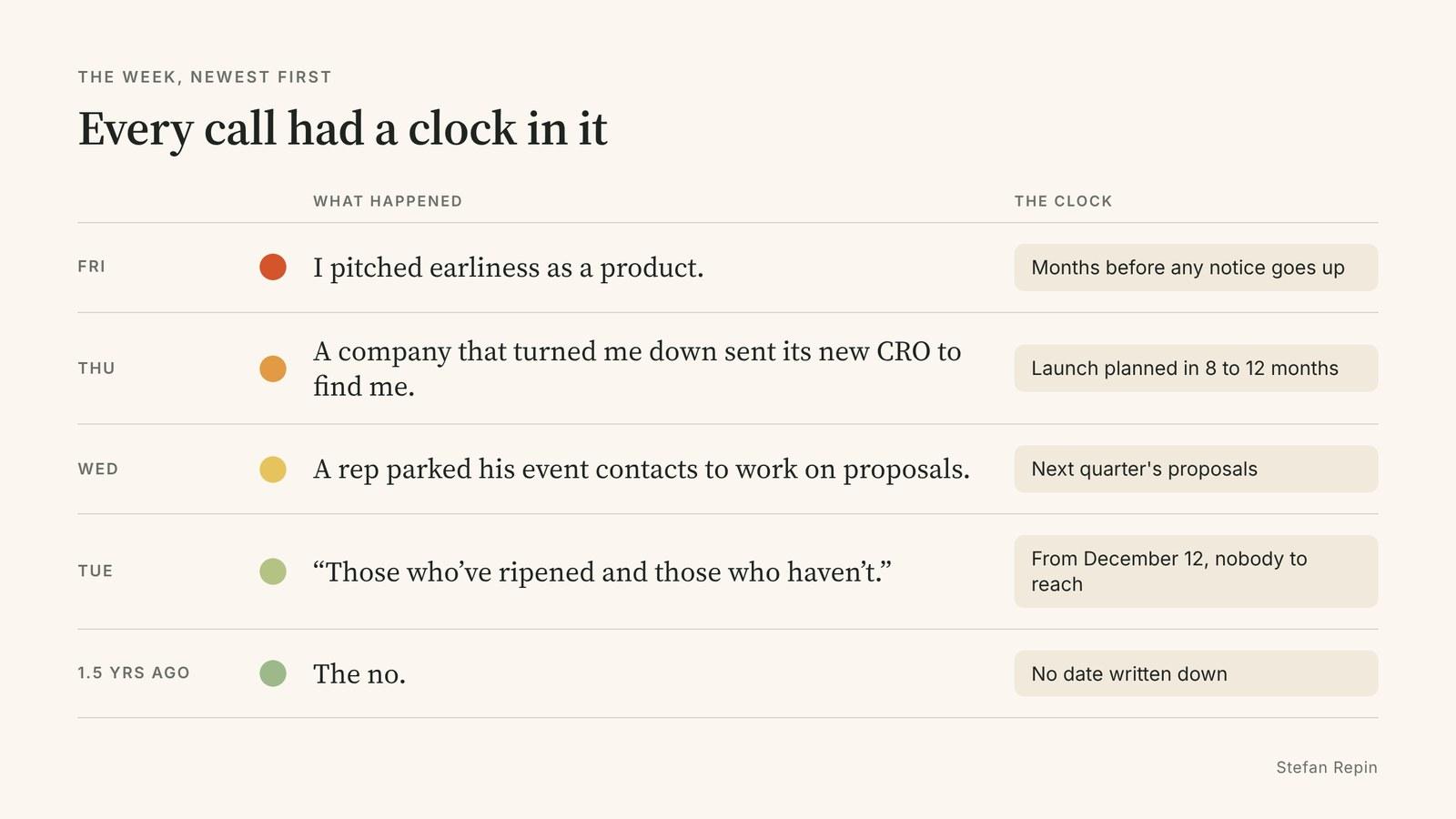
The weekKey learnings, newest first
I sell earliness for a living.
My partner, Alex, and I pitched a pre-tender intelligence product. His example: data on 700,000 citizens leaks. A security review follows. EU money is available. Stack those and you know a purchase is coming months before any notice goes up. "When the tender is already out, it's very likely they've talked to a few suppliers." I nodded along. Keep that in mind for the next part.
ReadA leak, a review and EU money stacked together announce a purchase months early.
A company that turned me down sent its new CRO to find me.
About a year and a half ago I did four interview rounds for a marketing role at a (undisclosed industry) software vendor. As part of the process I wrote them a go-to-market strategy for LATAM. They had two or three clients there. I also told them the automation they wanted would be very hard to build the way they wanted it. They picked someone else. I wrote to them afterwards and got "let's talk later."
On Thursday their new head of sales and I had a call. Someone senior had told him, "talk to Stefan." He'd read an article I once wrote about them. LATAM now has about ten clients and a full team. The strategy came up too. I said it on the call: "They used part of it. With a different marketer, mind you. It happens."
Then I used the word. "Funny that they've finally ripened enough to hire a salesperson in the States." He told me they'd been searching for about a year.
Read"New head of US sales hired" was the clearest sign this account had ripened.
He got in the same way I did.
The recruiter screened him out. The feedback was that he had no fire in his eyes. This is a man who was the first hire at a startup that grew to $20M ARR. A month later he wrote to them again: "I respect your choice and your process. It would still be interesting to talk." They met in August. The offer came in October. Same person, same CV, two months apart.
ReadSame person, same CV, two months apart.
I had read silence from this same company as a no.
He asked if I'd ever proposed a working model to them. I had. They asked for an offer, I sent one, and nobody answered. My exact words to him: "They didn't reply, so they're not interested. You know how it is." I said that to the person they had just pointed in my direction.
ReadSilence is not a verdict.

End of the day. His real target list is a calendar.
A trade show that cost around $30K gave him five demos. All five companies already run the big competitor system. One of them dislikes it, but they're on a global contract. I told him, "Honestly, nothing will happen." I still think that was the most useful sentence I said all week. There are high hopes, and then there is reality.
The accounts he actually wants are small companies with a launch planned in 8 to 12 months. "That's our target list, actually." Nobody has contacted them yet. Before he arrived, two colleagues spent seven months sending LinkedIn messages and booked zero meetings. His verdict: "In seven months I'd have walked to someone on foot." This kind of data is public record. The ripe accounts were sitting in a registry, with dates on them, while the team sent messages.
ReadThe ripe accounts were sitting in a public registry, with dates on them.
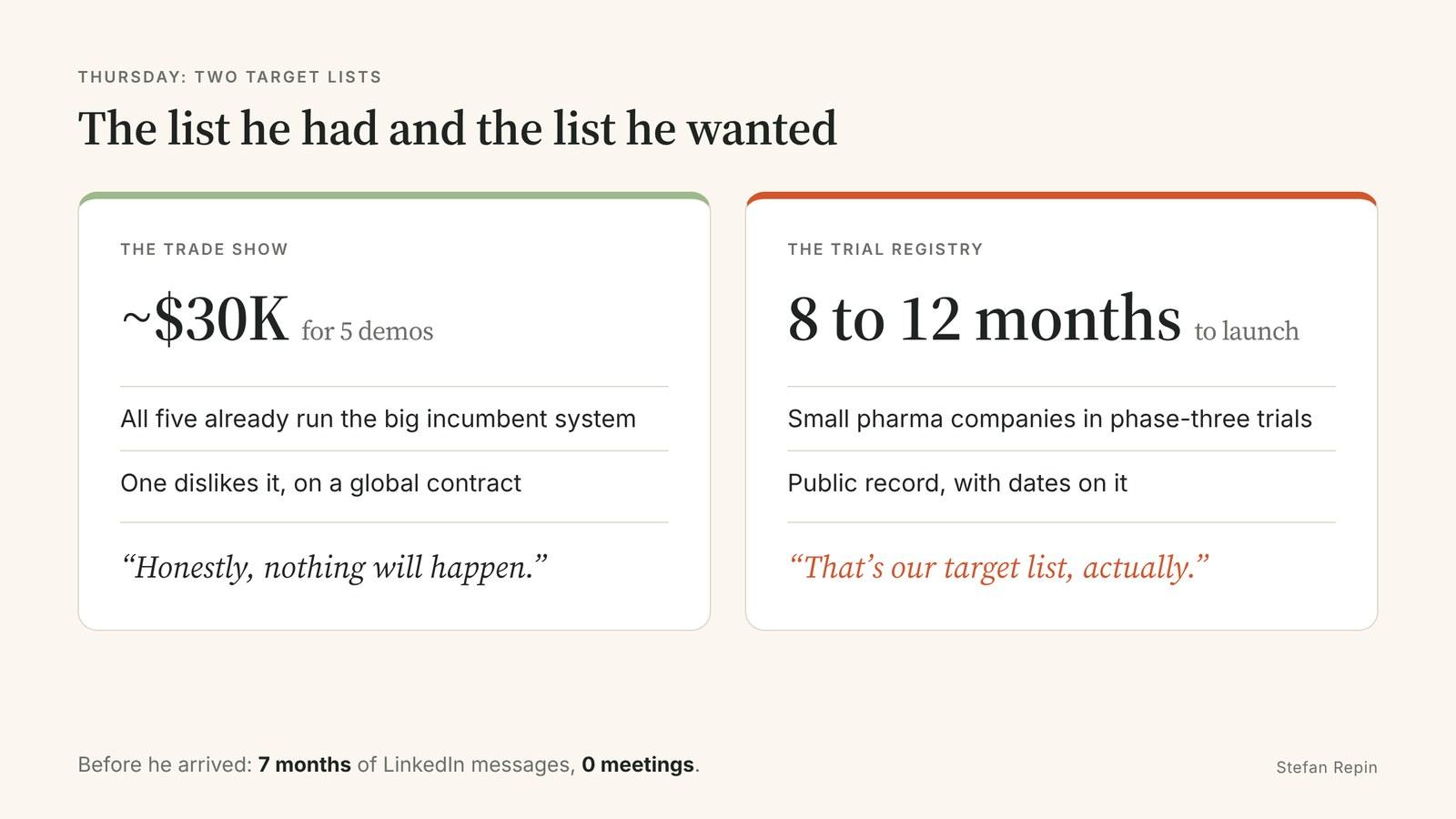

"In seven months I'd have walked to someone on foot."The new CRO, on seven months of LinkedIn messages and zero meetings
Ripe accounts eat all the attention.
My partner on an ABM project described a sales rep who came back from an event with very good contacts. Asked for a status, the rep sent a spreadsheet and "discussions are going on, it's great." Then the real reason: "I'm working on some proposals, so they are not a priority." My partner's reply: "ABM doesn't stop when there is a proposal." The rep is doing what most of us do. Proposals are the fruit you can pick today. The event contacts are next quarter's proposals and nobody is watering them.
ReadThe event contacts are next quarter's proposals.

I said the rule out loud and filed it under "interesting."
A client and I were trying to sort her leads into tiers. She said they have no checkbox list for it. I told her what a peer who runs ABM programs once admitted to me: his ICP clusters come down to two groups. "Those who've ripened and those who haven't." He'd stopped there.
She agreed straight away. You can't push someone into the funnel if they aren't heading there themselves, and the ones you spoon-feed become terrible clients. "A good client has to do their homework too." On the same call she gave me her market's clock without being asked. From about December 12 there is nobody to reach. When buyers do rush in during December to spend leftover budget, it almost never comes from outbound.
So on Tuesday I had the rule and a client's calendar. On Thursday I was living proof of it. On Friday I sold it as a product. I didn't write down a single date all week.
ReadFrom about December 12 there is nobody to reach.
The no.
Three things happened while the answer was no. I told them something hard in the interview. I left a strategy behind and they used it. I published an article about them. I can't tell you which of those brought the CRO to me, and I'd be lying if I picked one.
What I got wrong is easier to name. "New head of US sales hired" was the clearest sign this account had ripened. I build systems that catch that exact event for clients. I found out because he messaged me first.
ReadI found out because he messaged me first.
BreakdownTactical breakdown
What I did
Stayed loosely in touch after a rejection. Wrote about the company in public. Told a prospect plainly that one of his five deals would never move.
What went wrong
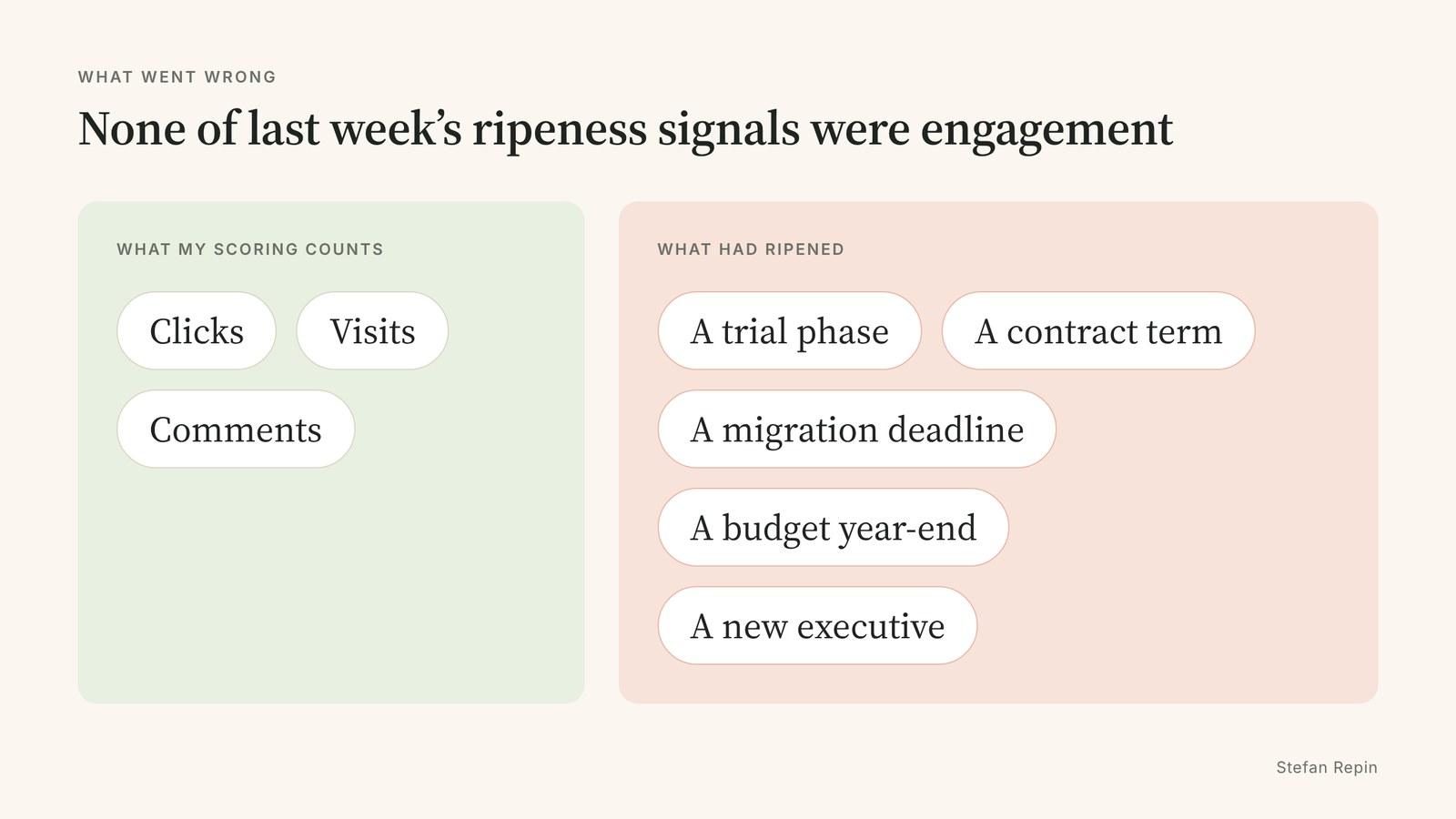
I treated silence as a verdict. I put no date and no trigger on any no. And the scoring I build for clients counts engagement: clicks, visits, comments. None of last week's ripeness signals were engagement. They were a trial phase, a contract term, a migration deadline, a budget year-end and a new executive.
What went right
"Nothing will happen" on the global contract. Being willing to say "this was hard the way you wanted it" in an interview I wanted to win.
What I'll do differently
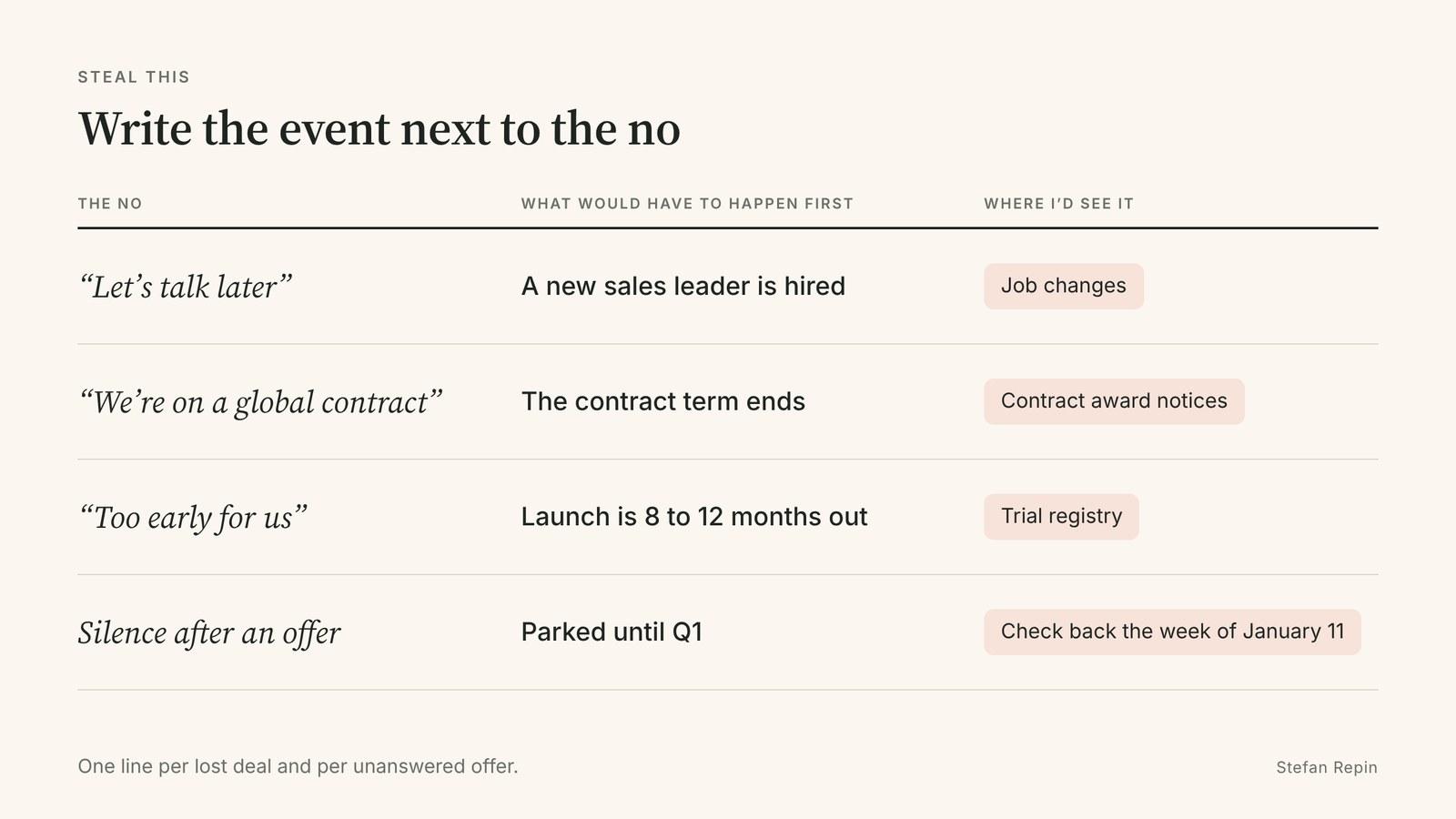
Every lost deal and every unanswered offer gets one line: what would have to change, and where I'd see it. The CRO's plan starts from the trial registry and works back from launch dates. My client's December rule goes into her engine as a rule, with the date in it.
Steal thisSteal this
Tick what you will try this week
ClosingStill open
The first time I heard this company's name, they had just beaten us in a tender in Hungary. Back then we reckoned a deal with a buyer that size took about two years to close. This one started a year and a half ago with a no, and it's still open.

About the author
Stefan Repin · LinkedIn
Builds signal and scoring systems for B2B companies with long sales cycles. Co-founder of Telltale with Alex Repin. Writes a field note from real sales calls most weeks.